
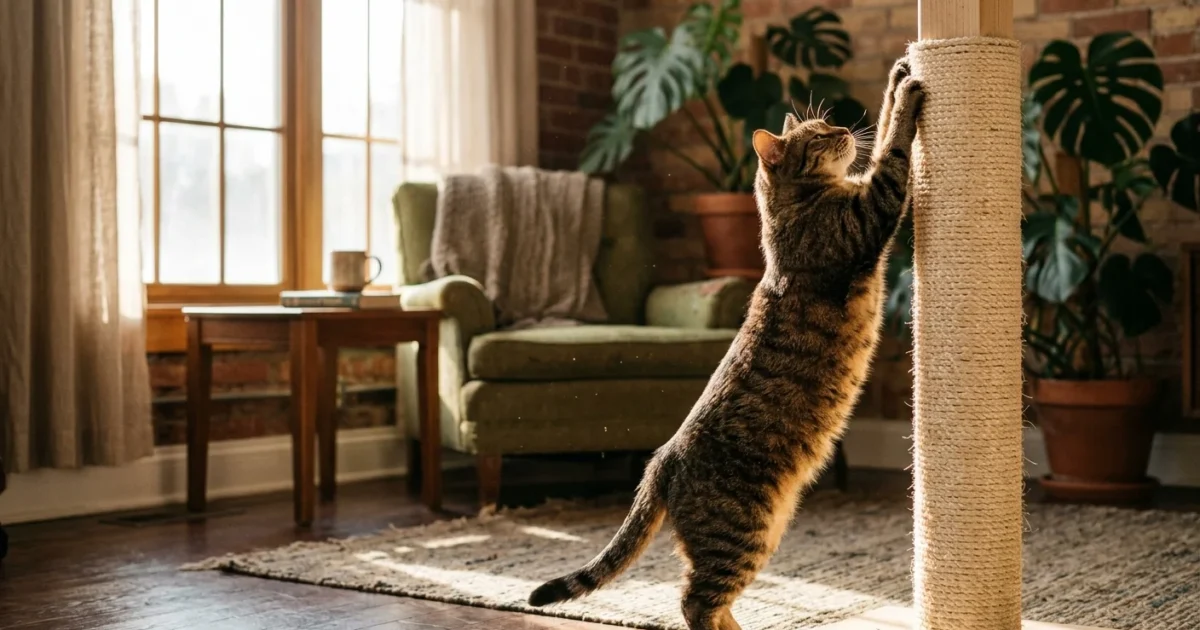
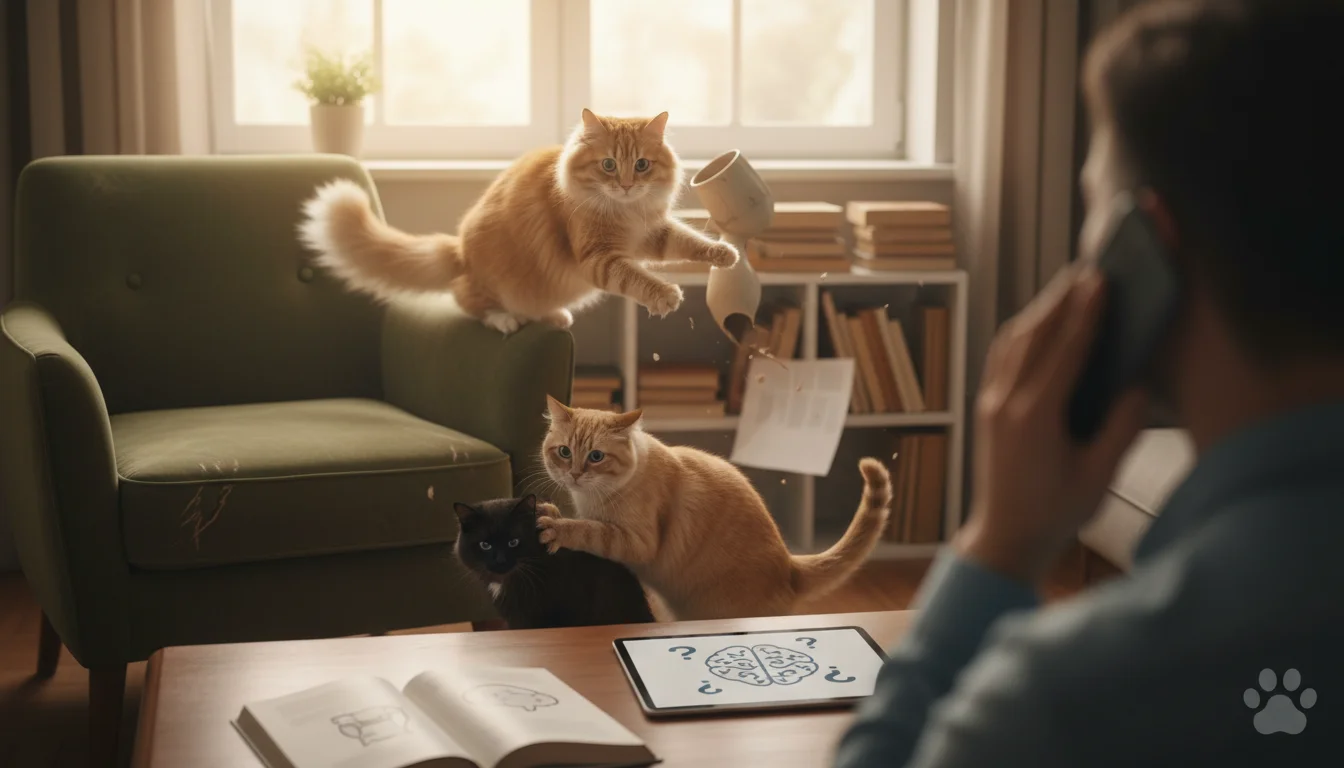
Redirecting your cat’s natural clawing instinct from your tailored couch to a designated post requires understanding the tactile feedback felines crave. Scratching serves essential physical and emotional purposes for your cat; it sheds dead outer claw husks, stretches tight spinal muscles, and deposits reassuring territorial scent markers from paw pad glands. When you match your home with the exact textures your feline companion instinctively seeks, destructive scratching stops almost immediately. Discovering the best scratching post materials for cats helps you build a harmonious environment where your furniture remains untouched and your cat stays mentally fulfilled and physically healthy.
Understanding Why Cats Scratch and How Texture Drives Choice
To end destructive clawing in your living room, you must first recognize that scratching is a non-negotiable physiological need for every cat. Felines do not scratch out of malice, boredom, or spite; they scratch because their anatomy demands it. According to research from the Cornell University College of Veterinary Medicine, scratching is an innate, essential feline behavior rather than a behavioral defect. Understanding what cats like to scratch requires looking closely at how a cat’s paws interact with different physical surfaces during a full-body workout.
Incorporating proper claw care into your regular cat grooming routine keeps their paws healthy and prevents uncomfortable nail snags.
Alongside providing satisfying textures, knowing how to trim your cat’s claws safely helps manage sharp points and prevents overgrown husks.
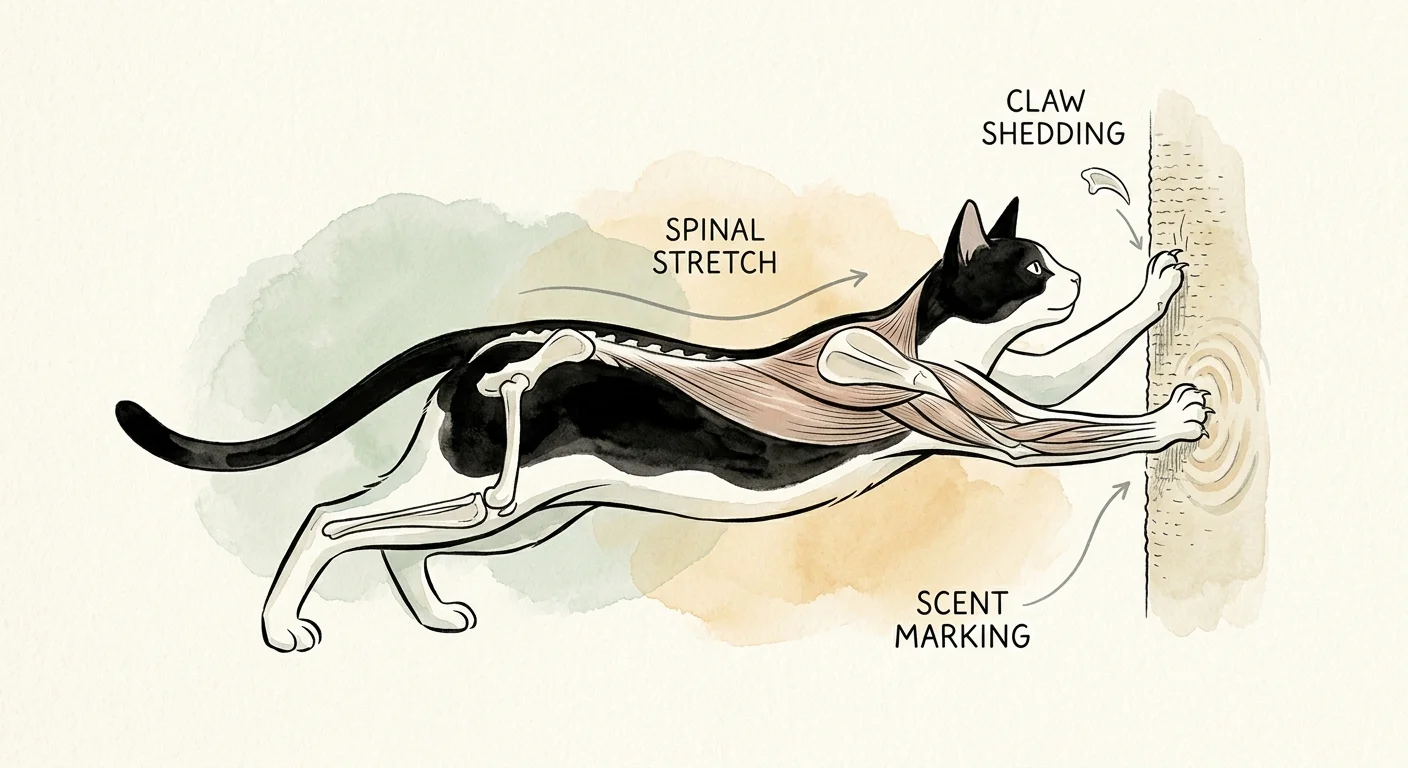
A cat’s claw grows from the inside out, accumulating dead outer layers called the stratum corneum. When your cat digs their claws into a yielding surface and pulls backward, the mechanical resistance strips away this outer husk to reveal a razor-sharp, healthy claw beneath. Without appropriate textures, these husks build up, causing discomfort, ingrown nails, and impaired movement.
Physical maintenance represents only half of the scratching equation. When your cat sinks their front claws into a post, they engage in a vital muscular stretch. This action extends the latissimus dorsi, shoulder girdles, and entire spinal column, releasing muscle tension accumulated during long catnaps. Simultaneously, tiny interdigital glands—specialized scent glands located between the toes—squeeze against the material. This action leaves behind invisible pheromones along with visible shredded grooves. Together, these cues establish a comforting sensory boundary that reassures your cat that their territory is secure.
Texture drives every decision your cat makes when choosing a scratching site. If a surface offers too little resistance, your cat cannot shed claw husks effectively. If it catches their nails painfully or slips under pressure, your cat will reject it. By analyzing the best scratching post materials for cats through the lens of tactile feedback, you can curate options that satisfy your cat’s clawing urges completely.
The 9 Scratching Surface Materials Cats Consistently Prefer
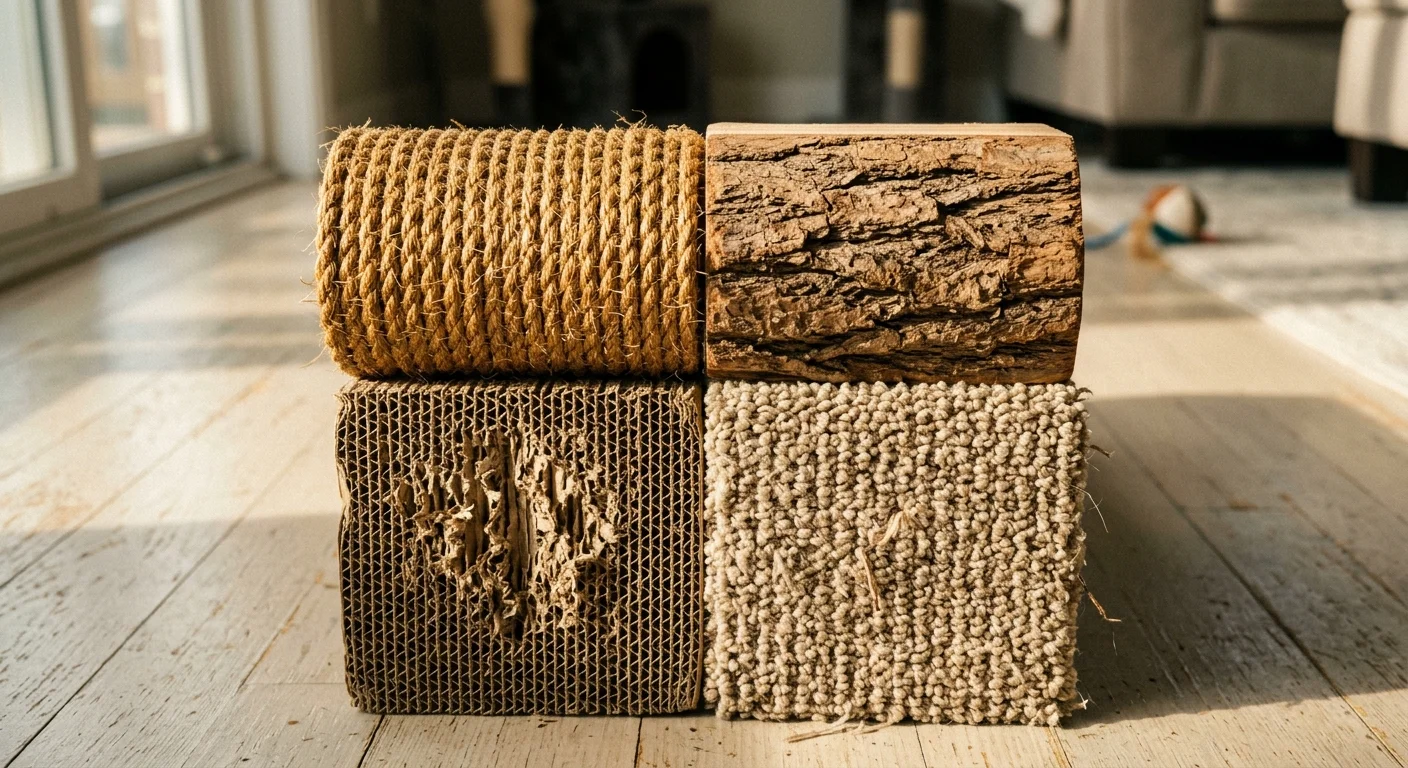
Every cat possesses unique tactile preferences influenced by age, wild lineage instincts, and personal history. Exploring a cat scratcher material guide allows you to pinpoint precisely which textures engage your pet’s interest. Here are the nine surfaces that felines consistently favor above all others.
1. Woven Sisal Fabric
Woven sisal fabric ranks as the undisputed gold standard among feline behaviorists and experienced cat parents alike. Unlike sisal rope, which is wrapped in spiraling coils, woven sisal fabric offers a continuous, flat weave made from natural agave plant fibers. When your cat sinks their claws into woven sisal fabric, the threads offer crisp, uniform resistance without trapping the claw tip. Your cat can drag their paws downward in a smooth, continuous stroke, generating ideal friction to shed dead husks. Sisal fabric lasts exceptionally long, shreds into satisfying vertical lines, and produces a subtle visual mark that cats love revisiting day after day.
2. Heavy-Duty Sisal Rope
Thick, natural sisal rope remains one of the most widely used scratching surface materials cats prefer. Manufactured by twisting raw agave fibers into dense strands, high-quality sisal rope provides a rugged, tactile texture that appeals to aggressive scratchers. However, rope thickness matters tremendously; thin 1/4-inch cord wears out quickly and can feel scratchy or sharp to delicate paw pads, whereas thick 3/8-inch or 1/2-inch unoiled sisal rope delivers ideal structural resistance. Make sure you select unoiled sisal, as oil-treated ropes used in hardware manufacturing contain chemical additives that off-gas odors offensive to sensitive feline noses.
Offering sturdy posts for vigorous clawing also provides an outlet to release stress and curb feline aggression in active multi-pet households.
3. High-Density Corrugated Cardboard
Cardboard scratchers have taken the pet world by storm, and for good reason. High-density corrugated cardboard features layers of fluted paper channels that create an irresistible tactile crunch under a cat’s paws. As your cat digs into the board, their claws easily penetrate the top layer, creating immediate shredding feedback that releases built-up energy. Cardboard excels at holding catnip scents deep within its honeycomb cells, making it an ideal surface for encouraging reluctant scratchers. While cardboard generates light paper debris that requires vacuuming, its low price point and high feline acceptance make it indispensable.
Because they are affordable and widely loved by felines, corrugated pads rank among the most practical budget-friendly cat supplies for everyday enrichment.
Pairing corrugated scratchers with interactive cat toys creates an engaging play zone that redirects pent-up hunting energy.
4. Natural Softwood (Pine, Cedar, and Redwood)
Before commercial pet products existed, wild feline ancestors sharpened their weapons against forest trees. Softwoods such as knot-free pine, cedar, and redwood mimic this primal instinct perfectly. Softwood offers a grain firm enough to resist initial claw impact yet soft enough for claws to gouge deep vertical grooves into the timber. As your cat scratches raw softwood, the wood releases natural aromatic terpenes while yielding to the claw’s pressure. This tactile interaction closely replicates natural tree bark, offering an extraordinarily satisfying outlet for energetic adult cats.
5. Heavy-Duty Natural Hardwood
For large, powerful breeds like Main Coons, Bengals, and Norwegian Forest Cats, soft materials might disintegrate too quickly or lack sufficient physical challenge. Raw hardwood—such as oak, maple, or dense birch—provides extreme mechanical resistance. While not every cat enjoys hardwood due to its rigid surface, cats with strong physical drives favor it. Hardwood posts require deep claw sinking, providing a intense workout for heavy shoulder muscles. When choosing hardwood, ensure the timber remains unvarnished and chemical-free so your cat can directly engage raw wood grain.
6. Upholstery and Heavy Canvas Fabrics
If you have ever caught your cat shredding the arm of your favorite couch, you already know how alluring heavy upholstery fabrics can be. Commercial furniture fabrics—such as heavy duck canvas, tweed, and microfiber—offer a dense, tightly woven matrix that catches claw tips comfortably. Cats favor these materials because they combine soft padding underneath with a tight surface texture. You can leverage this preference by introducing commercial scratchers wrapped in dedicated heavy-duty canvas or microfiber fabric, effectively satisfying their desire for furniture-like textures without sacrificing your home decor.
Rewarding your pet whenever they choose designated fabric scratchers over your couch is a wonderful way to strengthen your bond through positive communication.
7. Cut-Pile Carpet
Carpet remains a popular scratcher covering, but surface weave dictates whether your cat loves or rejects it. Cut-pile carpet features individual yarn tufts cut clean at the ends, leaving soft vertical fibers exposed. Cats enjoy sinking their paws into cut-pile carpet because their claws slide through the strands easily without snagging. However, you must carefully avoid loop-pile carpets (such as Berber carpet). Loop-pile carpet features continuous yarn loops that can hook a cat’s claw tightly, causing panic, torn nails, or painful toe joint injuries during a rapid scratching motion.
8. Jute and Hemp Fibers
Jute and hemp offer softer, more forgiving alternatives to coarse sisal fiber. Sourced from the stems of herbaceous plants, these natural plant fibers are woven into soft ropes or woven textiles that feel gentle on tender paws. Senior cats suffering from stiff toe joints, young kittens with delicate claw sheaths, and timid cats often find sisal too harsh or abrasive. Jute and hemp provide flexible resistance that shreds easily, allowing delicate cats to enjoy full clawing satisfaction without joint pain or skin irritation.
Positioning gentler fibers near an at-home cat grooming station makes daily paw care and relaxation effortless for sensitive cats.
9. Real Tree Bark and Log Slices
Nothing brings nature indoors quite like authentic tree bark attached to natural logs. Rough, ridged bark from trees like oak, birch, or cedar presents a rich, multi-textured landscape that stimulates every sensory receptor in your cat’s paws. Bark features varying densities, loose flakes, and deep fissures that challenge a cat’s grip, encouraging complex paw movement and deep muscle engagement. Sourcing dried, pest-free logs brings a outdoorsy enrichment experience into your home that indoor-only cats crave.
Introducing varied natural textures is also an excellent strategy to keep your cat entertained while you work during quiet hours at home.
To help you select the optimal material for your specific household, the table below compares each scratching surface across key practical factors:
| Scratching Material | Tactile Texture | Durability Level | Ideal Orientation | Best Suited For |
|---|---|---|---|---|
| Woven Sisal Fabric | Uniform, firm, non-snagging weave | Very High (Years) | Vertical / Incline | All adult cats, furniture scratchers |
| Heavy-Duty Sisal Rope | Coarse, ridged, spiral resistance | High (12-18 Months) | Vertical Posts | High-energy cats, strong scratchers |
| Corrugated Cardboard | Crunchy, shreddable, fibrous paper | Moderate (3-6 Months) | Horizontal / Incline | Kittens, catnip lovers, budget setups |
| Natural Softwood | Grainy, gougable, forest timber | High (1-2 Years) | Vertical / Log mounts | Active scratchers, outdoor converts |
| Natural Hardwood | Rigid, dense, heavy wood grain | Extremely High (Years) | Vertical Posts | Large breeds (Maine Coons, Bengals) |
| Upholstery Fabric | Dense, soft canvas / tweed weave | Moderate to High | Vertical / Furniture pads | Sofa scratchers needing transition |
| Cut-Pile Carpet | Plush, vertical yarn tufts | Moderate | Horizontal / Towers | Cats transitioning off home carpets |
| Jute & Hemp Fibers | Soft, flexible, yielding plant fibers | Moderate | Vertical / Horizontal | Senior cats, kittens, sensitive paws |
| Real Tree Bark | Rugged, deep fissures, varied ridges | High | Vertical / Natural logs | Enriched indoor cats, naturalists |
Orientation and Stability: Matching Texture with Structure
Selecting the best scratching post materials for cats solves only half of the equation; structure and orientation complete the puzzle. Even the most luxurious woven sisal or soft cardboards will be entirely ignored if the scratching post wobbles, slips, or forces your cat into an uncomfortable posture.
Paying close attention to your pet’s physical habits and posture preferences is also one of many meaningful ways to bond with your cat on a daily basis.
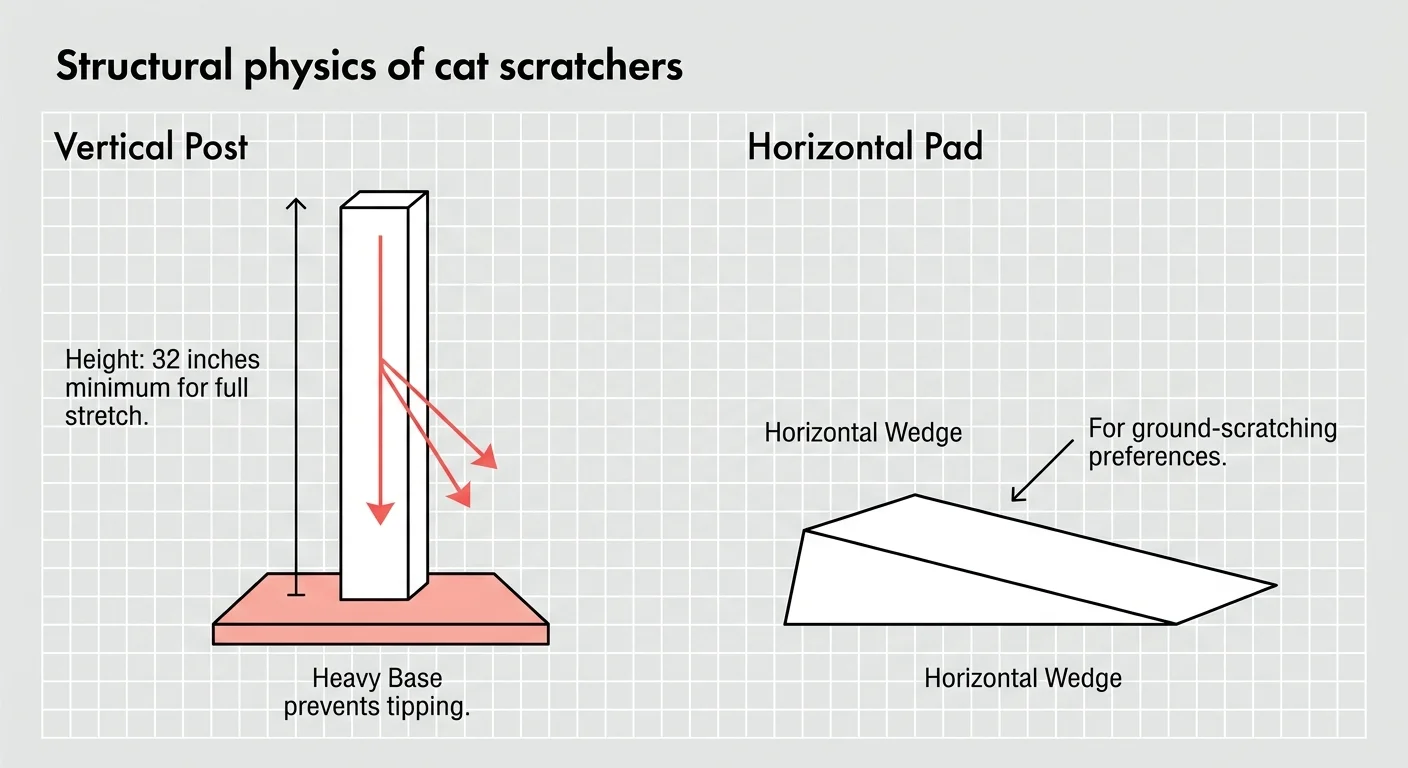
Cats approach scratching from three distinct anatomical angles: vertical stretchers, horizontal scratchers, and inclined scratchers. Vertical stretchers want to reach high above their heads, sink their claws in deep, and pull their body weight downward. For a vertical post to work, it must stand tall enough to allow your cat full spinal extension. A post that measures under 30 to 36 inches forces an adult cat to hunch, rendering it useless for muscle relief. Furthermore, base stability is crucial.
“If a scratching post shifts or wobbles under pressure, a cat will abandon it immediately in favor of a sturdy, immovable sofa arm.” — Certified Feline Behavior Specialist
Horizontal scratchers prefer spreading their body out along the floor, pushing backward with their hind legs while dragging their front claws forward over carpet or cardboard pads. This posture isolates the hip and lower back muscles. Inclined scratchers enjoy a middle ground, preferring a 45-degree angle ramp that lets them stretch without supporting their full body weight vertically.
Observe your cat’s current household habits to determine their preferred orientation. If your cat claws the vertical wooden arm of your couch, invest in tall vertical sisal or wood posts. If they target flat area rugs, introduce horizontal cardboard ramps or lay cut-pile carpet mats near those spots. Choosing the right cat scratching surface requires honoring their structural preference just as much as their tactile choice.
Age, Breed, and Health: Tailoring Surfaces to Your Cat
A cat’s ideal scratching surface changes dynamically across different stages of life and health conditions. As noted by the ASPCA, providing appropriate scratching surfaces matched to your cat’s age and physical capability prevents destructive household behaviors while keeping joints supple. Tailoring your selections ensures maximum comfort and physical benefit for your feline family member.
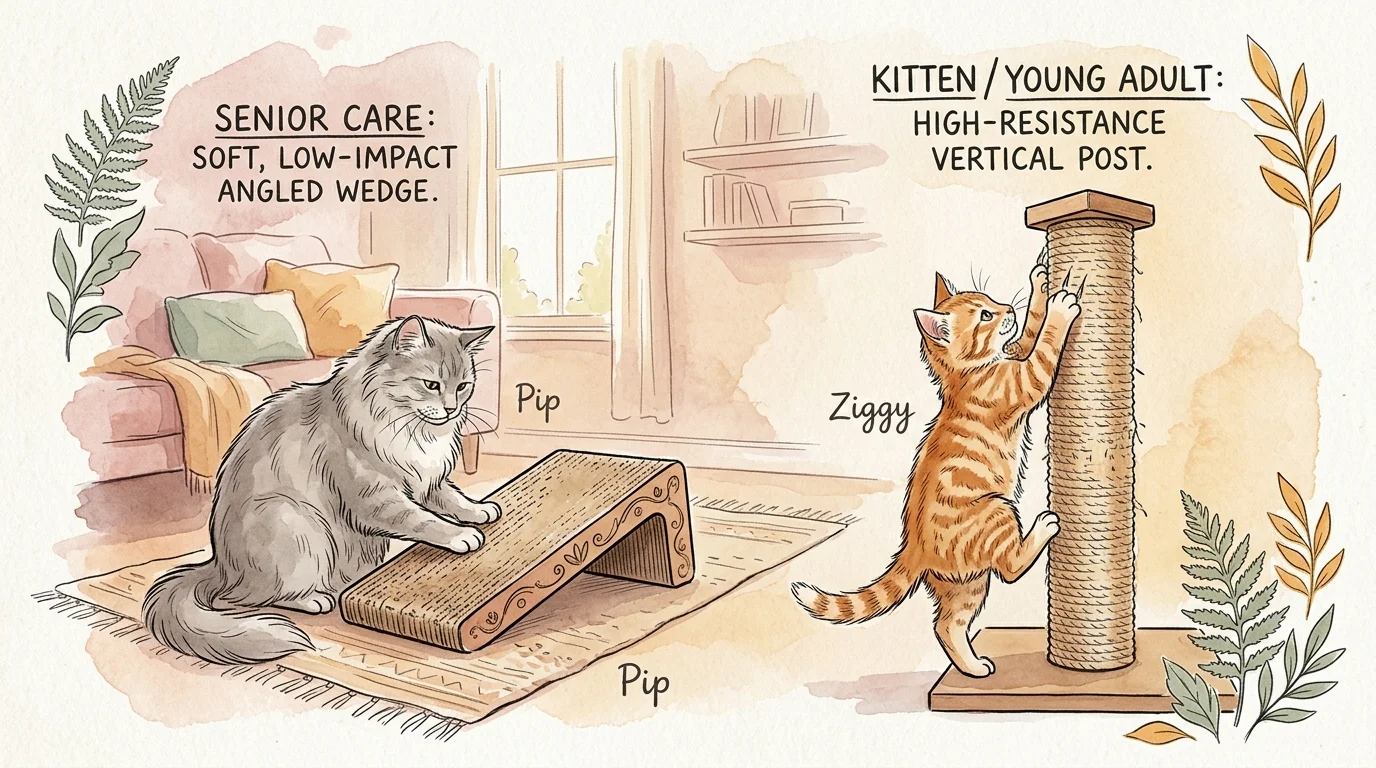
Kittens possess soft, rapidly developing claw sheaths and small bodies. Heavy, coarse sisal rope can feel overly abrasive on tender kitten pads. For young felines under six months, introduce lightweight corrugated cardboard pads, soft jute mats, and low-incline fabric ramps. These options allow young kittens to master claw conditioning without straining their growing joints.
Adult cats, particularly large structural breeds like Maine Coons, Ragdolls, and Savannahs, demand massive structural integrity and rigid resistance. These muscular cats can weigh between 15 and 25 pounds; a flimsy pet store post will tip over instantly under their leverage. Equip large breeds with solid hardwood posts, thick woven sisal towers anchored to wide plywood bases, or heavy natural log mounts.
Senior cats frequently suffer from feline osteoarthritis, stiff spinal columns, and thickened claw sheaths that do not shed as easily as they once did. Senior cats often stop using tall vertical posts because reaching upward hurts their sore shoulders and hips. Switch aging cats to gentle horizontal or low-angle incline scratchers covered in jute, soft hemp, or plush cut-pile carpet. Place these scratchers close to their favorite orthopedic resting beds so they can stretch comfortably without traveling across the house.
DIY vs. Commercial Scratchers: Budget-Friendly Texture Solutions
Creating effective cat scratchers does not require spending hundreds of dollars at boutique pet supply stores. In fact, DIY cat scratchers often outperform commercial models because you control the structural stability, post height, and material quality. Understanding commercial choices versus DIY alternatives helps you make budget-conscious decisions without compromising on feline satisfaction.
Commercial scratchers offer immediate convenience and polished aesthetics that blend into modern home decor. However, cheap commercial posts often suffer from major design flaws: short vertical posts under 20 inches, hollow plastic internal tubes wrapped in thin rope, and lightweight bases that tip easily. High-end commercial posts constructed from solid wood and woven sisal fabric last for years, but they carry premium price tags.
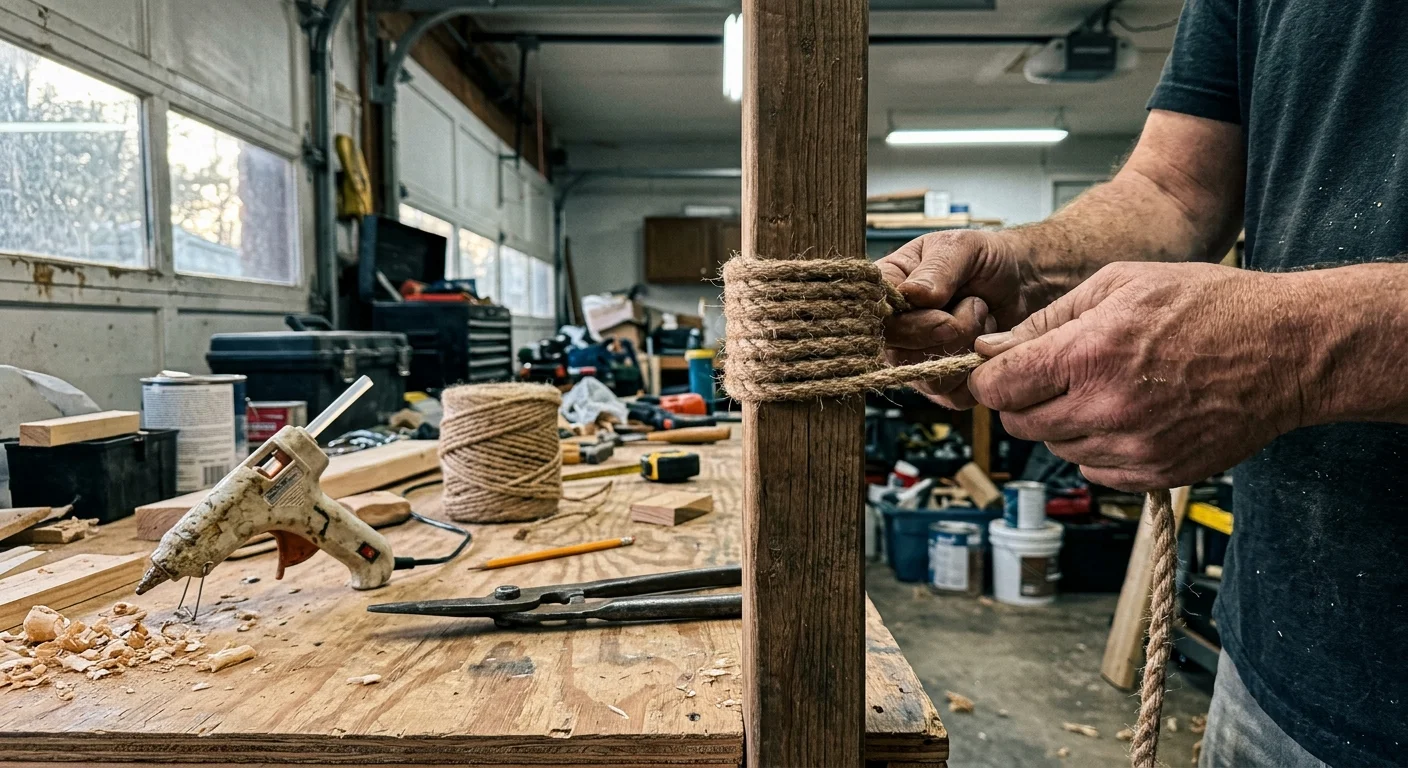
Building your own DIY scratcher allows you to craft customized solutions tailored to your cat’s exact physical proportions. You can purchase a heavy 4×4 wooden post from a local lumber yard, mount it securely to a heavy 24-inch square plywood base, and wrap it tightly in heavy woven sisal fabric or raw 3/8-inch unoiled sisal rope. You can also source fallen tree branches or logs from non-toxic tree species (such as apple, oak, or maple) for a natural, free scratcher. If sourcing outdoor wood, ensure the timber is thoroughly dried and free of pesticides or active insect infestations.
When assembling DIY scratchers, prioritize safety above all else. Use non-toxic, solvent-free hot glues or heavy-duty wood glues to secure fabrics and ropes. If using mechanical staples to fasten sisal fabric, drive them deep into the wood on the underside or structural corners where claw tips cannot catch on metal edges.
Strategic Placement and Positive Reinforcement Techniques
Even the absolute best scratching post materials for cats will fail if you hide them away in a dark basement corner or an isolated laundry room. Scratching carries an intense territorial component; cats want to leave visual and scent markers in high-traffic social areas where your family spends time. Guidance from The Humane Society of the United States emphasizes that placing posts in high-traffic social hubs—rather than isolated rooms—drastically increases your cat’s willingness to use them.
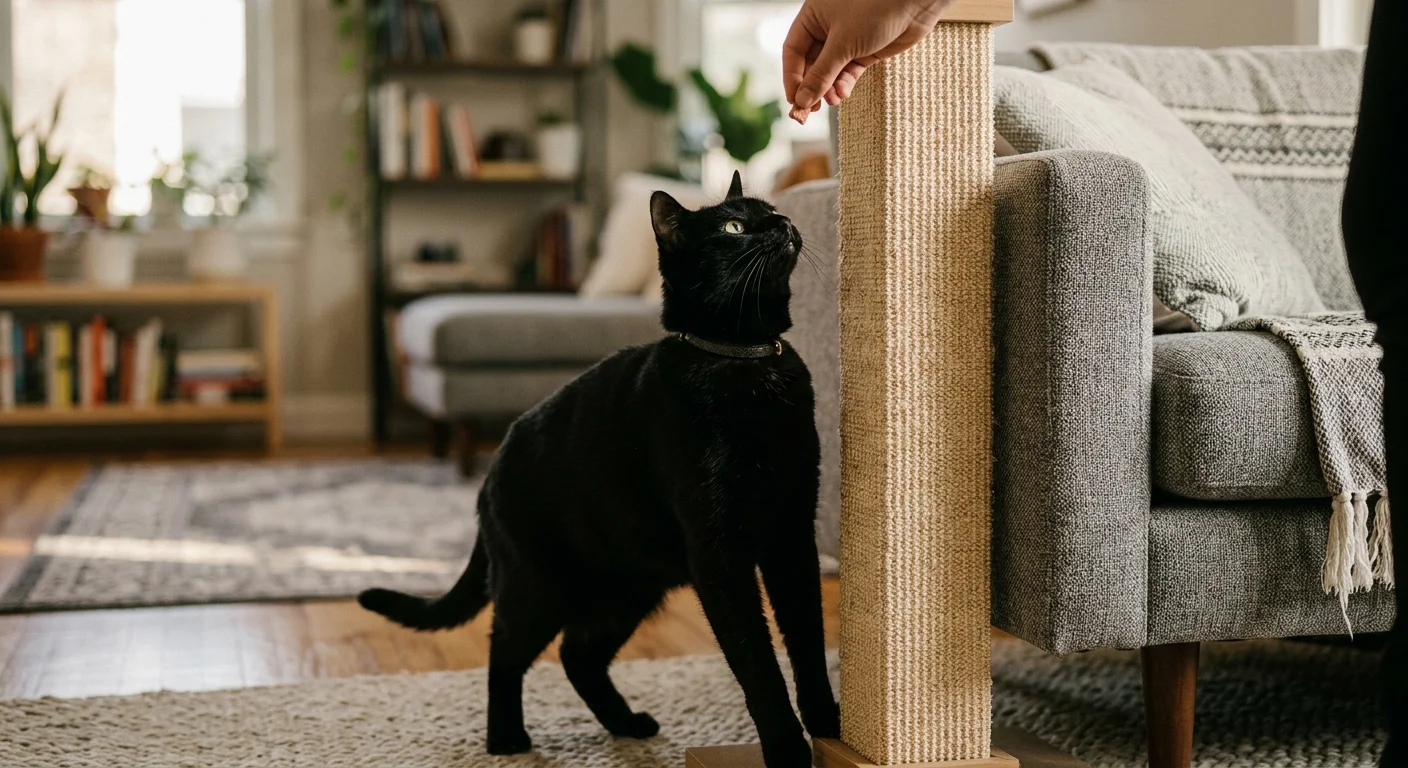
Position newly introduced scratchers immediately adjacent to key target areas. Place a post directly beside the couch corner your cat previously scratched, near primary room entryways, or right next to your cat’s favorite sleeping window perch. Cats frequently experience a powerful urge to stretch immediately upon waking, making bedroom and lounge perches prime real estate for scratcher placement.
To train your cat to embrace their new surface, rely exclusively on positive reinforcement and sensory lure techniques:
- Scent Enhancement: Rub organic dried catnip, silvervine powder, or valerian root powder directly into the fibers of the sisal fabric, cardboard flutes, or wood grain to entice curiosity.
- Interactive Play: Use a wand toy with feathers to dangle lures around the post. Encourage your cat to chase the lure up the post so their claws land on the preferred texture naturally.
- Clicker Training & Treat Rewards: Whenever your cat approaches, sniffs, or places a paw on the new surface, immediately mark the behavior with praise and deliver a high-value treat.
- Scent Transfer: Gently drag a soft cloth across your cat’s cheek glands and rub it onto the new scratcher material, making the new object smell familiar immediately.
- Cover Old Targets: Temporarily cover illegal target areas (like sofa corners) with double-sided sticky tape or smooth plastic furniture guards while placing the new post directly in front of the blocked area.
Never grab your cat’s paws and forcefully rub them against a scratching post. Forceful handling induces intense fear, causes negative associations with the post, and destroys the trust bond between you and your cat. Always allow your cat to explore and engage textures on their own timeline through positive motivation.
Common Mistakes That Sabotage Scratcher Acceptance
When pet owners struggle with persistent furniture destruction, simple design or management oversights are usually to blame. Avoiding these common mistakes will accelerate your success when introducing new materials:
- Throwing Away Shredded Scratchers Too Early: Humans dislike shredded cardboard or frayed sisal, but cats prefer worn surfaces. Shredded materials hold deep scent markers and offer pre-loosened grooves that feel satisfying to claw. Only replace scratchers when they lose structural stability.
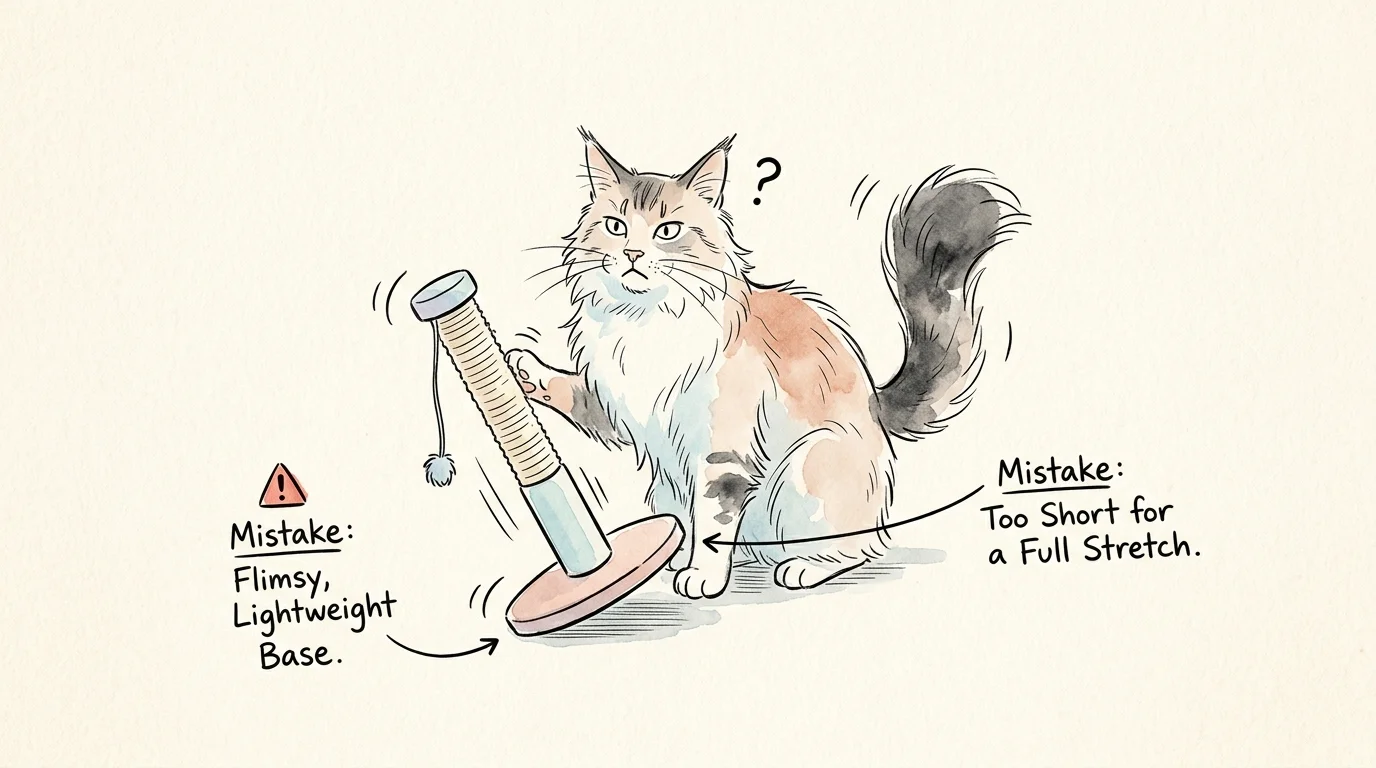
- Selecting Posts That Are Too Short: Buying a standard 20-inch post forces adult cats to crouch. Choose posts that measure at least 30 to 36 inches tall to allow full spinal extension.
- Using Unstable or Top-Heavy Towers: Lightweight posts that tip or slide across hardwood floors instill fear. Always anchor scratching posts to heavy, broad bases.
- Relying on Loop-Pile Fabrics: Avoid Berber carpets or looped ropes that snag claw tips, which can trap claws and cause serious toe injuries.
- Cleaning Scratchers with Harsh Chemicals: Using strong chemical disinfectants strips away the natural pheromones your cat deposits, prompting them to abandon the post. Spot clean with mild, unscented soap and water when necessary.
- Punishing Unwanted Behavior: Yelling, squirting water, or clapping frightens your cat without addressing their underlying physical need to scratch. Punishment increases anxiety, which often leads to increased scratching elsewhere.
Frequently Asked Questions
What is the best scratching post material for cats overall?
Woven sisal fabric is widely considered the best overall material. It offers incredible durability, smooth vertical resistance, and allows claws to drag cleanly without getting caught or tearing threads. Unlike sisal rope, which wears out in specific spiral bands, woven sisal fabric distributes wear evenly and lasts for years.
Why does my cat prefer scratching my carpet over their post?
If your cat targets carpet, they are expressing a horizontal scratching preference. Standard vertical posts do not satisfy their desire to stretch flat along the floor. You can solve this by providing horizontal scratchers covered in cut-pile carpet, flat woven jute, or wide cardboard pads directly over the carpet spots they currently target.
Should I replace a cat scratcher once it looks shredded and messy?
No, do not replace a scratcher simply because it looks cosmetically worn. Cats prefer shredded, fraying surfaces because the loosened fibers permit deep claw penetration and hold strong territorial scent markers. Only replace or re-wrap a scratcher when it loses structural integrity, sags completely, or stops standing securely.
Is sisal fabric better than sisal rope for cat scratchers?
Yes, sisal fabric is generally superior to sisal rope. Sisal rope creates ridged gaps between spiral wraps where claw tips can snag awkwardly. Woven sisal fabric provides a smooth, uniform surface that lets claws drag fluidly in a natural downward stroke, offering superior tactile feedback and far greater longevity.
How do I train my cat to use a new scratching surface?
Place the new scratcher directly next to the object your cat currently scratches illegally. Apply organic catnip or silvervine powder into the material’s fibers, and use feather wand toys to entice interactive play on the post. Whenever your cat uses the surface, immediately reward them with high-value treats and praise. Never force or drag your cat’s paws onto the material.
For expert pet care guidance, visit
Fear Free Pets, The Spruce Pets, Rover — Pet Care Blog, Preventive Vet and American Veterinary Medical Association (AVMA).
Disclaimer: This article is for informational purposes only and is not a substitute for professional veterinary advice, diagnosis, or treatment. Always consult with a licensed veterinarian for medical concerns about your pet.

Leave a Reply