
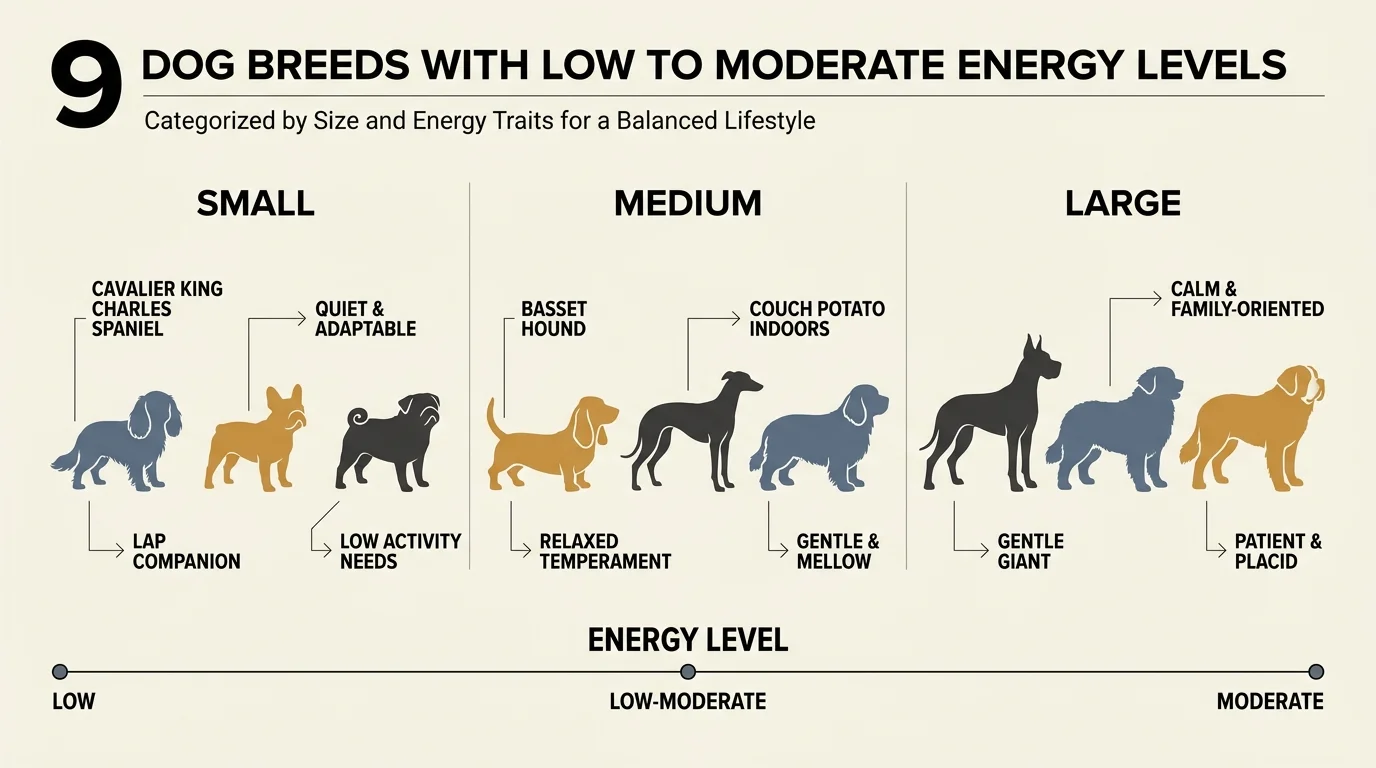
Breed Comparison Summary
To help you determine which of these calm companions might best fit your living situation, review the comparison table below outlining their general size, grooming needs, and daily exercise requirements.
To support their physical health and easygoing nature, always ensure you are feeding them the right food for their specific life stage.
| Dog Breed | Size Category | Grooming Needs | Exercise Needs |
|---|---|---|---|
| Cavalier King Charles Spaniel | Small | Moderate (regular brushing) | Light to Moderate |
| Shih Tzu | Small | High (daily brushing or clipping) | Light |
| Pug | Small | Moderate (wrinkle care, heavy shedder) | Light |
| Basset Hound | Medium | Moderate (ear and wrinkle care) | Moderate (sniff-focused) |
| English Bulldog | Medium | Moderate (wrinkle cleaning essential) | Light |
| Whippet | Medium | Low | Moderate (short sprints) |
| Greyhound | Large | Low | Moderate (short sprints) |
| Newfoundland | Giant | High (heavy shedding and drooling) | Moderate |
| Bernese Mountain Dog | Large | High (frequent brushing needed) | Moderate |
Frequently Asked Questions
Do calm dog breeds still need daily exercise?
Yes, absolutely. A calm demeanor does not eliminate the need for physical activity. Every dog requires daily movement to maintain cardiovascular health, joint mobility, and a healthy weight. For most calm breeds, a 30- to 45-minute structured walk, supplemented by indoor play and bathroom breaks, is entirely sufficient. Skipping exercise can lead to obesity and unexpected behavioral issues, even in naturally lazy dogs.
Are calm dogs easier to train?
Calm dogs often present fewer chaotic behaviors—such as jumping on guests or frantic leash pulling—which can make the training process feel smoother. However, low-arousal dogs sometimes lack the intense drive and eagerness to please found in working breeds like Border Collies. You must figure out what motivates your calm dog, whether that is a high-value food reward, gentle physical praise, or simply the promise of a nap after a short training session.
Can a high-energy breed become calm over time?
All dogs naturally slow down as they transition from puppyhood into their adult and senior years. A high-energy breed will become significantly calmer with age, proper training, and consistent fulfillment of their physical and mental needs. However, you should never adopt a high-energy working breed expecting them to organically adopt the lifestyle of a Basset Hound. Their baseline need for activity will always remain higher than a breed selectively bred for companionship.
What is the best calm dog breed for seniors?
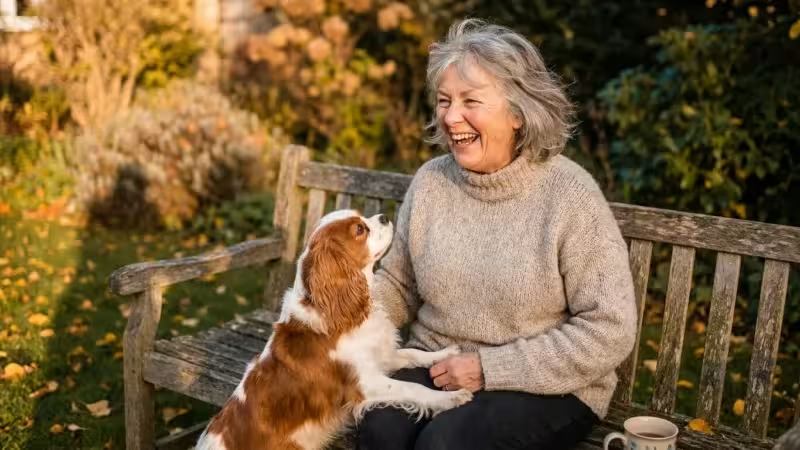
For seniors, small companion breeds like the Cavalier King Charles Spaniel and the Shih Tzu are often highly recommended. They are affectionate, deeply devoted, and easy to manage physically. Because they weigh less than twenty pounds, they pose minimal risk of pulling an owner over on a leash and are easy to transport to the veterinarian. A retired racing Greyhound is also an excellent option for seniors who prefer a larger dog, provided they have access to a safely fenced area for the dog to stretch their legs occasionally.
For expert pet care guidance, visit
Preventive Vet, American Veterinary Medical Association (AVMA), American Kennel Club (AKC) and Cat Fanciers’ Association (CFA).
Disclaimer: This article is for informational purposes only and is not a substitute for professional veterinary advice, diagnosis, or treatment. Always consult with a licensed veterinarian for medical concerns about your pet.

All this talk about “mental stimulation” is B. S. To me. I have a Llewellin Setter and I have done puzzle games, training, kongs, hide and seek, etc, etc…. along with fetch and walks..he is still hyper. At 7 pm to 10 pm he is on 10 and I cannot get him calm. I’m tired of buying all these enrichment games cause he needs “mental stimulation”. It is a scam
I get it, but it depends on the breeds needs too. Setters are bred to run in fields and uneven terrain- maybe a sporting competition or other exercise or running program, if he’s healthy enough (as cleared by a vet). Get more suggestions by the vet team and if he’s too much on overdrive, ask about other suggestions for calming him down. Best of luck!
I’ve never heard of that breed before so I’m not familiar with their activity level. Apparently that breed is supposed to be calm? I guess this one is an Exceptional One. Could sound like one of mine, LOL !!! Sorry I have no advice but Good Luck.
Hey Bill! I feel your pain. I have a dog I rescued who’s more needy with medical stuff then with what you’re going through but I have had many dogs who exhaust me so much especially as I’m getting older. I asked myself WTF am I doing? I can say that so many dogs get no attention at all great kudos for your efforts to try to give your dog a good life. I think they’re like kids. Everyone is different. Good luck with your pup. Hope you get some sleep tonight.😊